Saturday, April 13, 2013

Writing about Unfertilized Egg (farm unit)

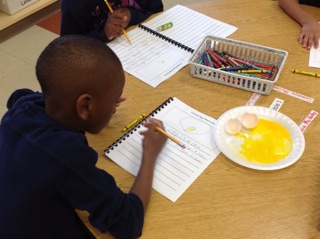
We wanted to teach the students about different types and reasons for writing, so as their writing during the farm unit they will be writing in a book titled, “My Farm Book”, which is essentially a writing journal for each student. The first entry in their journal was labeled “Cracked Egg Observation”. The student’s observed/touched a cracked egg so they could see what the embryo ate to keep growing while in the egg. I explained that once the egg yolk was gone, the baby chicks would be ready to hatch! I was really impressed by their observations! Below are some student examples. 

Tuesday, April 9, 2013

Semantic Feature Analysis Chart and learning about chicks (farm unit)

So yesterday, (previous blog), we completed an open sort or classification of different pictures that could be found in the city and/or country. The students really gave great rationale for why certain pictures went with each other. They came up with 5-6 different ways to sort this.

I am blogging about this activity today, even though it does not use the ipad and technology, because the discussion with kindergartners was so rich and deep. It really allowed the students

Day 1-Introduction to farm
Open sort/classification country/city pictures
Read Country Kid, City Kid by Julie Cummins


Chart-Similarities between city and country
Writing integration-Where would you rather live, city or country? Justify your answer with supporting sentences.

Day 2-Chick egg introduction (I would not always do this activity on the second day of this unit, but the live chick eggs arrived today and so it is important to introduce them, explain and show the incubator that will be in the classroom for the next 21 days.)

In our morning meeting and letter to the students, I wrote the sentences "How does the hen nurture the growth of the chick? How can we nurture the growth of the chick?" These questions were the guiding questions for the students as I read the story. I read a book about chicks. (I have about 15 different ones and most tell the life cycle so all can work).

I introduced the semantic feature analysis chart. (see picture).


I had prewritten the focus question "What does a fertilized egg need to hatch into a chick?", the left column (hen and incubator), and the lines for the chart. During the reading, the students had opportunities to discuss the chicks and how they growth. We then completed the chart. They came up with the features on the top of the chart.

When we came to food, that is when the discussion really began. One child talked about giving the chick corn (as stated in the book). However, the chick does not eat corn when in the egg. They were trying to figure out how the chick gets food. I facilitated the discussion. I then drew the eggs at the bottom explaining that one day 1, the chick is in the egg. What do they eat? On day 2, the chick is in the egg. What do they eat? On day 3, the chick is in the egg. What do they eat? All the way to day 21 when they break out of the shell and then can eat the corn. The students came to the conclusion that what is in the egg is what the chick eats. Eventually the students stated that the yolk was the food (which is correct). It was such an exciting discussion as the students are working to figure out how chicks eat because you need food to survive. We had to add egg underneath the incubator to the chart. We continued our discussion and the students came up the feature shelter. Again, the students realized that the egg shell protects the chick.



Monday, April 8, 2013

Individual video for Fixing Misunderstandings

I had a couple of students that did not do well on the word study assignment given to them. It can be hard to spend the five minutes (or less) needed to fix misunderstandings and check comprehension of the task with 25 other children in the room.

So I made an Educreations lesson designed just for them. They watched this video lesson prior to the word study activity. My intest of the lesson was to give them additional strategies (in this case, arm blending) when they sound out each word. I believe they were sounding out each word but with arm blending they can better isolate the sound they need to focus on. I went over each picture or word with them and practiced the strategy with them. I then took a picture of their word study activity from the day before and I went over their work with them, focusing on the errors they had made. Then I took their iPad and created the educrations video on their ipad. I gave them a picture of the educrations app so they knew they have a video to watch.

http://www.educreations.com/lesson/view/jalen-c-fix-it/6187130/


http://www.educreations.com/lesson/view/willie-fix-it/5863446/


These 2 minutes that I used to prep was so valuable because the students got their individual help and my word study lessons could continue. I did this for 4 students on this day (total of 10 minutes of prep time). The students next activity or repeated activity (depending on the child) was successful.

Open Sort Classification Activity

Our staff has been participating in critical thinking continuum PD for the last quarter. One of the sessions focused on open sort classification. So, we are beginning a farm unit. Initially, my teaching partner and I were planning on having the students do a open sort on the ipad individually. They would download the pictures from Dropbox on the Educreations app. The students would sort the pictures and record their reasoning/rationale of their sort. At the last minute, we changed our mind and decided to do the open sort/classification activity as our Do Now. Well, my Do Now took 20 minutes and the students were completely engaged. They came up with multiple ways to sort these objects. It was amazing.

Attached is the educreations activity we did together. I projected the pictures on the screen. I moved the pictures and wrote the words. I also repeated what the students said so all could hear and any audience listening/watching would be able to hear as well.

http://www.educreations.com/lesson/view/classification/6679829/


Upon reflection, the value of doing this activity as a whole class is amazing. I don't think I would get these kind of answers if the students did the activity by themselves (actually I know I wouldn't). I would get the one way they sorted it. I think possibly by having some groups, there would be more of a chance to get this same kind of discussion and critical thinking by the students. I am glad that this was a whole activity. I am excited to do the next one.

The key to the open sort is that there are multiple ways to sort. The squirrel and then I added the children quickly at the last moment (instinctually) technically fit in both farm and city sorts but made the students really defend their answers and explain their rationale for where they put each object.

Sunday, March 10, 2013

4 Word Study Groups-1 Teacher

Well, just my luck! I lose my voice for 3 days. Diagnosis: laryngitis. I have two residents so they helped alot but I still needed to do word study and guided reading groups.

Solution: iPads. I wrote scripts for my husband (who is not a teacher) and he read and recorded them while I wrote on Doceri what I wanted the students to do. The students listened to the movies they uploaded from Dropbox. I didn't have to sync to each iPad and each group listened to the movie.

Based on previous experience, I uploaded the exact movies in another folder on Dropbox because you just never know when a student might "accidently" delete a movie.

This is actually something I will use when my residents leave and still have 6 guided reading groups and 4 word study groups. I can still have instruction daily with each group using the iPad.

Here are the videos I had him make:

Monday, February 25, 2013

Exit Slip--Coin Names and Values

We are working on counting coins--right now just nickels and pennies. First, the students are given a cup of coins (pennies and nickels) and a felt mat. The felt mat is used to silence the coins. This really makes a difference as the students are counting coins in quiet voices.

When done with the counting coins activity, the students did an exit slip on the iPad. They used Educreations app and then used Dropbox to upload a picture of a penny and a picture of a nickel. The students than were asked to identify the coin and the value of the coin. In the past, I had to go to each student to ask them the name and value of the coins. This was so much quicker.


http://www.educreations.com/lesson/view/wynter-coins/5258519/

Other activities I do to practice counting money is a toy store or snack shop. I have little toys (pencils, erasers, tattoos, and other toys) for the students to buy. I give them a cup of coins and they have to count out the right amount of money to purchase the different toys. These toys they can actually keep. They have to read the price of the toy, find the right amount of money needed, count it aloud to me, and then keep their toy.

Wednesday, February 13, 2013

Story problems--Students explain their thinking

We have been working towards having students complete story problems and explain how they got their answer on the iPad. This allows us, the teachers, to be "right next to each student" while working the problem. I may not be able to actually sit by each student but I can address their misunderstandings and great thoughts afterwards through a video or sitting one-on-one with them by learning what they did while working the story problem.

We took baby steps to get there. I think the first step is to have them talk into the iPad. Initially, they were hesitant. We are still working on making sure all 100% of the students are talking into the iPad, they are recording and saving their work, they are doing the work expected from them, and the noise level in the classroom is conducive to recording multiple children at the same time.

For this activity, we used Dropbox (my new favorite app) for the students to get the written story problem from. I would change the the story problem so it fits on 2 lines. If the students weren't careful, the story problem did not fit great on the screen. So by making sure it fits easily, then the students can upload the story problem and start without asking for help. (Independence!). The students then read the story problem and draw a picture and writte the number sentence and explain how they got the answer. This was the expectation articulated to them. We provided the word "story" for them to save it. The rest they did on their own.

Here are some examples of students who completed the number problems on their own. (We also had a group of students who worked with the teacher as well).

Breonna actually did all the work and then explained how she did it.
http://www.educreations.com/lesson/view/breonna-strop/4875897/


Katelynn did most of the work and then wrote the number sentence while recording. She is starting to use some transitional words in explaining the math.
http://www.educreations.com/lesson/view/katelynn/4875872/

Charles talks us through how he did the problem, though he doesn't write the number sentence.
http://www.educreations.com/lesson/view/charles-story/4875745/